
Safer Roads at Night with Solar Studs
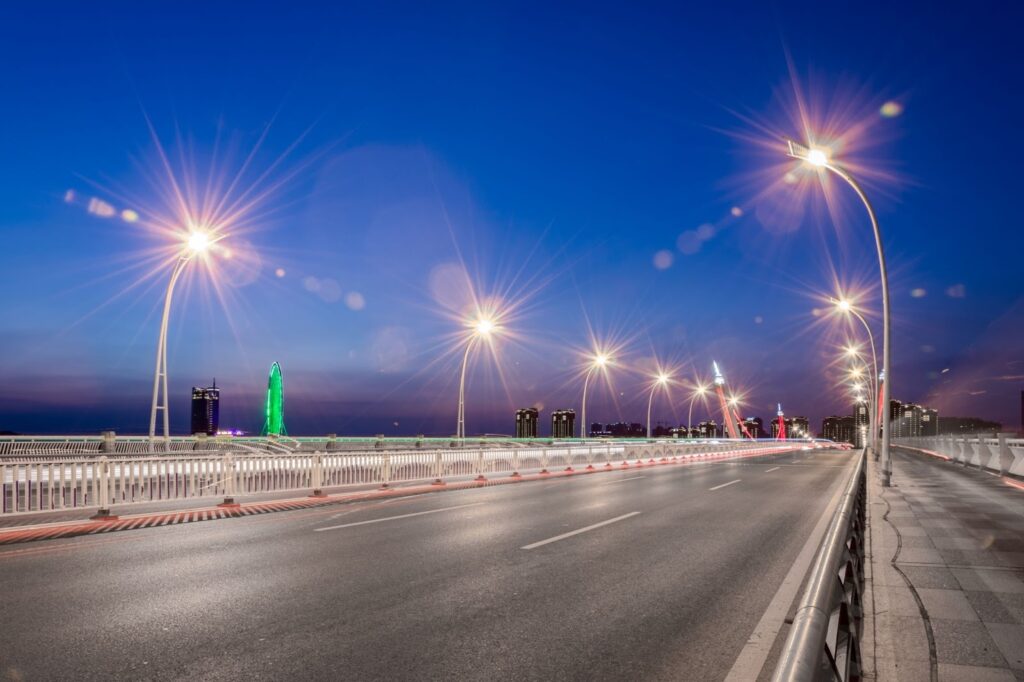
Nighttime is over-represented in fatal crashes. Although they represent about 25% of total driving time, nighttime driving is the cause of about half of all fatal road accidents in many nations. Poor visibility and depth perception, along with additional time required to identify potential hazards, combine to impair the performance of drivers in ways not experienced during the day. “To mitigate this risk, infrastructure solutions need to actively direct rather than passively reflect light, and solar road technology is quickly emerging as one of the best tools for doing just that.”
Visibility Challenges on Roads After Dark
The basic problem with night driving is that vehicle headlights have a very limited field of view. Standard headlights often provide too little illumination to stop safely if a hazard jumps out at highway speed, a deficiency that traditional road paint and passive reflectors are ill-equipped to address. The weather makes it worse. Fog, rain, and road spray also scatter headlight beams and diminish the retroreflective response of painted lane markings, making them nearly invisible in light to heavy rainfall. Roads that are well-marked on a dry sunny day can become confusing after just a little rain.
Conventional raised pavement markers and retroreflective studs rely solely on the illumination of an oncoming vehicle’s headlights to work. They do not emit their own light, and therefore their visibility is directly affected by the angle, intensity, and state of the oncoming beams a dependency that impairs their utility when the need is greater.
How Solar Road Studs Improve Road Guidance
Active solar road studs are, at their core, different from passive reflectors; they produce an output luminoso, making visible at distances significantly higher and in conditions where these types of retroreflective systems simply quit or disintegrate as being useful.
Each module features a photovoltaic panel that charges an on-board battery during the day. An ambient light detector and a microcontroller turn on the LED modules at sundown, and the modules emit a continuous or a sequential flashing light during the night without any power supply connected. Being able to see at distances of more than 800m compared with around 100 m for traditional reflective road studs — this is a major increase in the amount of early warning drivers receive.
A good solar road stud will hold this performance in rain, fog, and under low-angle lighting conditions that will render passive markers ineffective. The active light source penetrates atmospheric scattering, unlike reflected light, allowing for uniform lane guidance in all weather conditions.
Role in Preventing Accidents and Enhancing Lane Discipline
Improved lane marking is associated with fewer lane departure events – these are unintentional lane departures and are responsible for a large portion of nighttime single-vehicle out-of-control and head-on crashes. Along lane borders, centerlines, and edge lines, solar studs are placed to give a continuous visual anchor, which helps with lane keeping without much driver input or interpretation.
Winding road sections and highway interchange configurations are particularly hazardous at night, since the directional change of the road may not be visible to a driver until he is fully committed to an unsafe line of travel. Sequential solar road stud systems along curve alignment offer superior geometric definition compared with static markings, enabling motorists to receive advance warning, at an earlier and clearer stage, of the steering input needed.
The approaches to the intersections and pedestrian crossing areas are similarly affected. Active light output at these high-conflict points makes drivers more aware of the advance decision points of travel there, potentially allowing more time to react and thus helping to prevent the last-minute panic decisions that have been cited in contributing to crashes at intersections.
Conclusion
Solar road studs fill a night/time road safety infrastructure deficit that is arguably the most stubborn and has the greatest impact on safety. These modify passive light reflections by active light emissions, providing reliable lane guidance even in weather conditions and light levels where conventional systems are known to perform poorly. For road owners who are looking for affordable, off-grid answers to the risk of road accidents at night, the technology of the solar stud can deliver quantifiable, proven safety benefits in an unparalleled range of deployments.
Ai Report
